
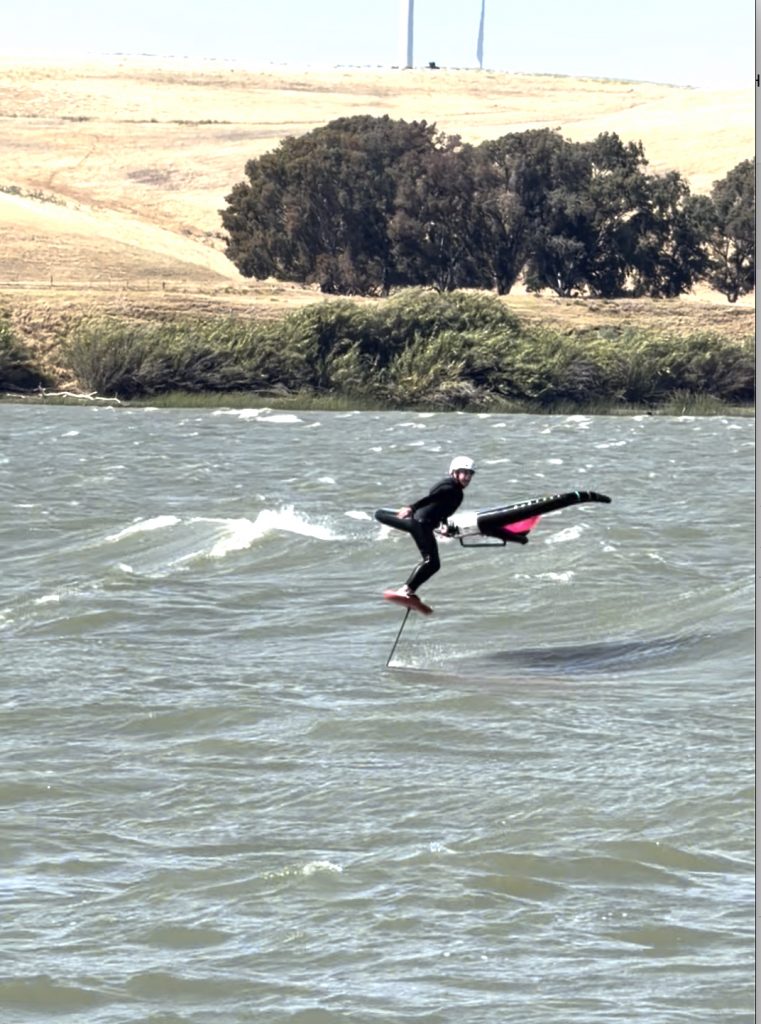
Tides and currents are two reasons that Sherman Island gets so much action for wind sports in the summer months. But did you ever stop to consider what exactly is happening? When the tide is going down, or ebbing, and water flows towards the Pacific Ocean, from the Central Valley and the Sierra Nevada, it is moving against the direction of the prevailing westerly wind. Steep waves form, making the conditions wind riders and paddlers love.
When the tide comes in, called flooding, the Sacramento River starts flowing in the opposite direction than the river naturally flows. With flooding, the water actually flows “upriver” at Sherman Island, and flows in the same direction as the wind. The surface flattens and the apparent wind decreases, creating conditions that are more beginner-friendly. However, with the water and wind moving in the same direction, the challenge for the rider is to keep from losing ground downwind.
The movements of water in the ocean, or currents, are a result of many factors: salinity differentials, temperature differentials, prevailing winds caused by semi permanent pressure fields, and tides. Currents created by tides are almost imperceptible out in the ocean, as the energy is spread out through the vast open waters. But when the huge volume of water is forced into a narrow bay, inlet or channel, that speed increases dramatically. The difference can be from under 1 mph to over 10 mph.
And, when the tide decreases and the water flows out, the current also increases. In a positive feedback loop, the smaller the channel gets from water flowing out, the faster the current speeds up. As the passage gets more narrow, the water receding flows faster.
In addition, at Sherman Island, the ebb goes against the westerly winds coming in from the San Francisco Bay, The ebb also flows in the same direction as the natural outflow of the Sacramento River, also adding to the speed of the ebb.